
News
HMRC E-Invoicing Roadmap: From April 2029, a PDF Will Not Count as a VAT Invoice Between VAT-Registered Firms
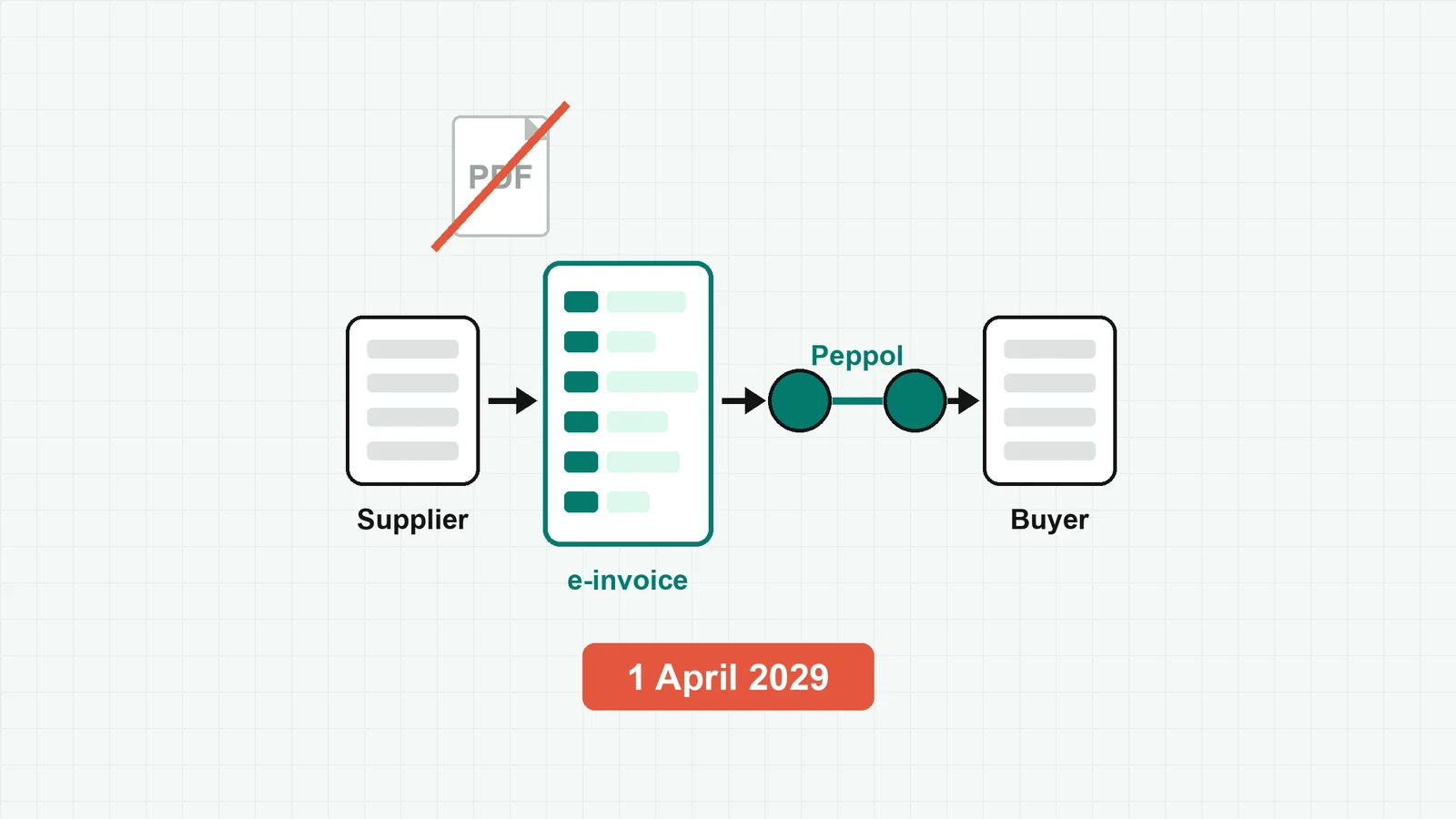
HM Revenue and Customs and the Department for Business and Trade published the UK's e-invoicing implementation roadmap with Budget 2026, at 13:49 UTC on 28 October 2026 [1]. From 1 April 2029, VAT-registered businesses, charities and public bodies must issue VAT invoices as e-invoices and be able to receive them, unless a specific exemption applies.
The line that matters for anyone who runs invoicing software: invoices sent as a PDF, a word-processed file, a JPEG, HTML on a web page or in an email, or a fax "do not count as e-invoices" [1]. An e-invoice is structured data exchanged directly between the supplier's and the buyer's financial systems.
What the roadmap says
- Scope. Taxable supplies between VAT-registered persons where a VAT invoice is required today. Sales to consumers and cross-border invoices are outside it; firms that are not VAT-registered may join voluntarily [1].
- Network. Peppol is the UK's core interoperability framework. Most firms will reach it through an Access Point provided by their software provider. HMRC will take over as UK Peppol Authority from NHS Supply Chain; when is not yet set [1][2].
- Notice. The full requirements (exemptions, standards, business identifiers, software provider obligations) will be published between October 2027 and April 2028, at least 12 months before the start [1].
- Law. Finance Bill 2026-27 will carry the enabling powers and is expected to become law in Spring 2027. The detailed regulations may not be made until Autumn 2028 or early 2029 [1][2].
- Money. HMRC expects the measure to raise £140 million in 2029 to 2030 by closing part of the tax gap [2].
- Reporting is separate. A second consultation asks whether HMRC could later receive selected e-invoice data. No decision has been taken; it closes on 20 January 2027 [3].
Key dates
| When | What |
|---|---|
| 28 Oct 2026 | Roadmap and digital reporting consultation published |
| 20 Jan 2027 | Digital reporting consultation closes |
| Spring 2027 | Technical consultations on UK standards and Access Point certification; Finance Bill expected to become law |
| Autumn 2027 | Guidance on EDI and other legacy systems |
| By end of 2027 | Guidance for groups with specific rules |
| Oct 2027 to Apr 2028 | Requirements, standards, business identifiers and software provider rules published |
| By Apr 2028 | Exemption process, taxpayer obligations and updated VAT guidance |
| Summer 2028 | Readiness testing with software providers |
| Winter 2028 | Infrastructure and governance operational |
| 1 Apr 2029 | E-invoicing for VAT invoices takes effect |
Source for every row: the roadmap [1], except the consultation close [3].
What it means for your systems
Invoices from mainstream accounting software. The roadmap expects providers to add e-invoicing, and says several have committed to include it in their core package at no extra cost [1]. Ask yours whether it will run its own certified Access Point or use another provider's.
Invoices from your own systems. If VAT invoices leave a platform you built, a billing or booking system, or a script that emails a PDF, that path must produce structured invoice data and hand it to an Access Point by April 2029. The PDF can stay as a human-readable copy; it stops being the invoice.
AI or OCR that reads supplier invoices. Many finance teams now read PDF invoices from an inbox with OCR or a language model. From April 2029, VAT invoices from UK suppliers should arrive as data, so that extraction step becomes a fallback for overseas and non-VAT invoices rather than the main route.
EDI. Firms may keep EDI links, but must also be able to exchange e-invoices through the new framework; guidance is due in Autumn 2027 [1].
Master data. Every user will register a business identifier on Peppol. The UK has no single identifier for all organisations and has not chosen which ones it will accept; the roadmap names VAT registration numbers as one example [1]. Clean supplier and customer records now cost little.
HMRC itself says there is no need to start implementing before the detailed requirements are published [1]. What you can do now is list every system that issues or receives a VAT invoice, its format and its monthly volume.
What is not decided yet
Which business identifiers the UK accepts; any UK-specific Peppol requirements and whether software providers need UK accreditation; exemptions beyond digitally excluded persons; the penalties (the government plans to build on the existing VAT invoice penalties); when HMRC becomes the Peppol Authority; and the cost to businesses, which HMRC will publish with the regulations [1][2].
Our take
Opinion. The real risk is not April 2029; it is buying or building invoice tooling in 2027 that cannot speak Peppol. If you are choosing a billing platform, an accounts payable tool or a document AI vendor now, ask for their Access Point plans in writing. In custom code, keep the invoice as data and treat the PDF as one rendering of it; then 2029 means adding a connector, not a rebuild. We wrote about turning documents into verified data in PDF and document automation for apps and APIs.
Sources
All read on 29 October 2026; times are UTC.
- HM Revenue and Customs and Department for Business and Trade, "Roadmap for e-invoicing implementation", published 28 October 2026 13:49 UTC: scope, what is not an e-invoice, Peppol and Access Points, every key date, business identifiers, EDI, penalties, "no need to begin implementing", Finance Bill and regulation timing. https://www.gov.uk/government/publications/e-invoicing-implementation-roadmap/roadmap-for-e-invoicing-implementation (read 18:30)
- HM Revenue and Customs, "E-invoicing requirements", tax information and impact note, published 28 October 2026 17:36 UTC: enabling powers in Finance Bill 2026-27, the Peppol Authority now at Supply Chain Coordination Limited (NHS Supply Chain), Exchequer impact, business costs to follow with the regulations. https://www.gov.uk/government/publications/vat-electronic-invoicing/e-invoicing-requirements (read 18:30)
- HM Revenue and Customs, "E-invoicing digital reporting" consultation, open 28 October 2026 to 20 January 2027 23:59: no decision taken on digital reporting, how to respond. https://www.gov.uk/government/consultations/e-invoicing-digital-reporting (read 18:30)
How we made this: drafted with AI tools from the primary sources listed above, then checked fact by fact against those sources by a second reviewer on 29 Oct 2026. Opinion is labelled "Our take". This is a source-based report, not a hands-on test.